Money
Tokyo Metro tap-to-ride: can you skip buying Suica?
Since 25 March 2026, the ticket gates at Tokyo Metro and Toei stations — and at nine more Kanto rail operators — read your contactless credit card directly. A Visa, Mastercard, JCB, American Express, Discover, or UnionPay in your wallet is now the ticket. You do not need to buy a Suica first.
You still need a Suica for everything else. JR East (Yamanote, Chūō, Sōbu, the Narita Express) is not in the scheme. Buses are not in. Shops, konbini, vending machines, and coin lockers all take IC, and many still refuse foreign cards.
The scheme covers 729 stations across 54 lines. It has failure modes worth knowing about before you rely on it — the wrong card, the wrong wallet, the wrong sequence, and one small surcharge no seller will mention.
| You are… | Payment |
|---|---|
| On Tokyo Metro, Toei, Keio, Tokyu, Keikyu, Odakyu, Seibu, Tobu, Sotetsu, or Yokohama Minatomirai | Contactless card (or Apple/Google Pay wrapping the same card) |
| On JR East (Yamanote, Chūō, Sōbu, N’EX) | Suica / PASMO / Welcome Suica |
| On a bus, or paying at a konbini | Suica / PASMO or cash |
| Not sure your card has contactless enabled | Buy a Welcome Suica at the airport, keep the tap for later |
What actually works at the gate
The scheme covers eleven Kanto rail operators: Tokyo Metro, Toei, Keio, Tokyu, Keikyu, Odakyu, Odakyu Hakone, Seibu, Tobu, Sagami Railway, and Yokohama Minatomirai Railway. Interoperability went live on 25 March 2026, at 729 stations across 54 lines. The same card works at any of them, and the reconciliation between operators happens in the background. Read that station count as a floor rather than a promise: Odakyu Hakone, Seibu and Tobu are in at some stations only, and the operators say coverage will be extended to the rest over time. Tokyo Metro is the exception — every line of it is in, with one small catch below.
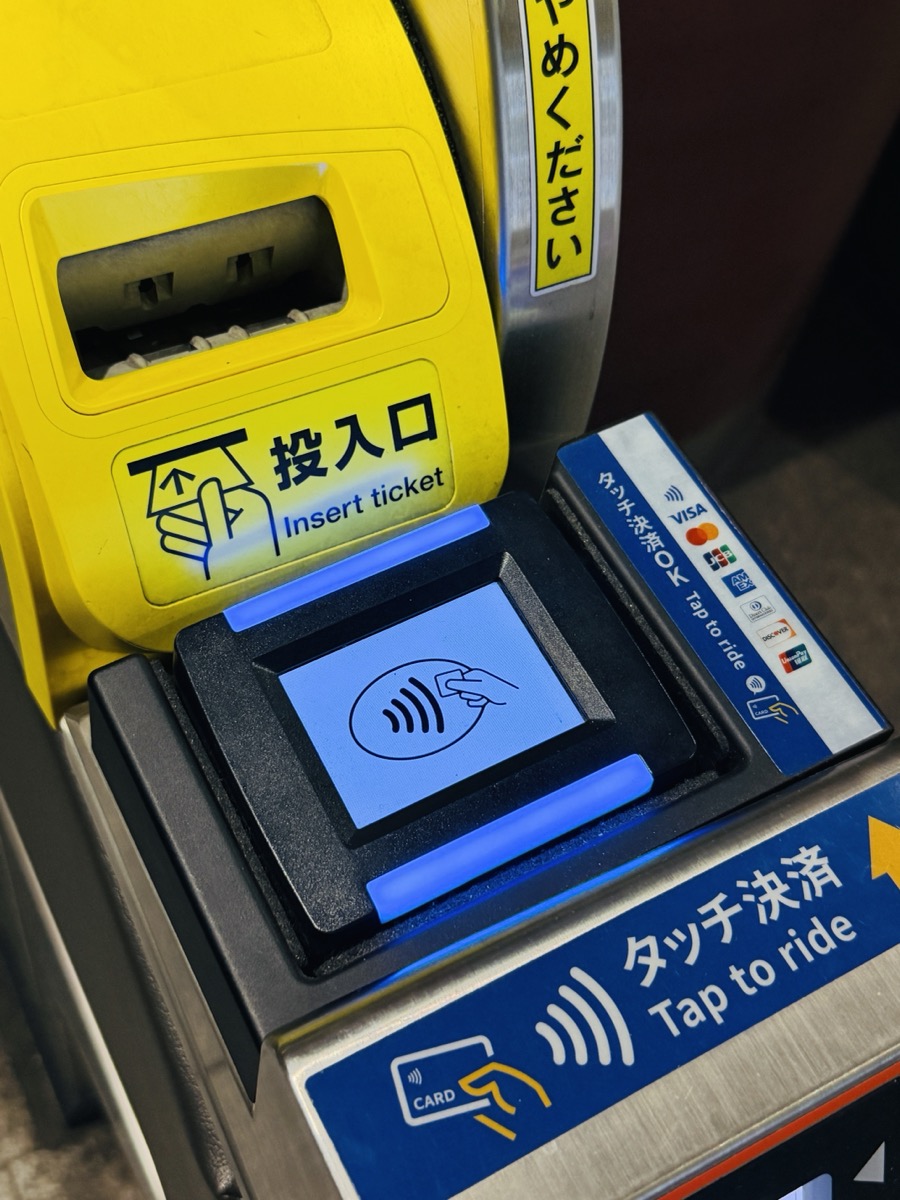
What the operator actually commits to is narrower than the brand lists you will see quoted around: any card, debit or prepaid card included, carrying the tap-to-pay logo. The sticker at the Otemachi gate on the day this was checked showed six brands — Visa, Mastercard, JCB, American Express, Discover and UnionPay — with Diners Club absent, though it appears in scheme-level descriptions elsewhere. Stickers vary by operator and by station. Look at the gate you are about to use.
One rule the brand lists never mention: child fares do not exist here. A child may only tap a card in their own name, and the fare charged is the adult one. A family of four tapping four cards pays four adult fares. If you are travelling with children, the IC card is not the old-fashioned option — it is the cheaper one.
Both the physical card and the same card wrapped in Apple Pay or Google Pay work at the same reader. There is one strict rule that will fail you if you do not know it: tap out with the same device or card you tapped in with. Apple Watch in, physical Visa out is a gate error. So is physical Amex in, Apple Pay Amex out on your phone — the operator is explicit that the same card number on a phone still counts as a different medium. Nobody at the counter warns about this.
A Tokyo Metro line also gets you a ¥70 discount when you change to a Toei Subway line, tap or no tap, provided you re-enter within sixty minutes. It is the only discount the scheme applies. Every other fare reduction you may have read about — passes, commuter tickets, shareholder benefits — is off the table the moment you tap.
For getting on the Tokyo Metro, you no longer need a Suica. Nobody selling you a Suica will tell you this.
The fare charged to a tap is the paper-ticket fare, rounded to ten-yen increments. Tokyo Metro’s shortest hop is ¥178 on Suica and ¥180 by tap. That is one to two yen more per ride, every ride. Three rides a day is five yen. It is not a reason to avoid tap; it is a rounding error you should know about. The eleven operators’ pages state the rule; no visitor guide states the consequence.
When tap fails
The first failure mode is boring but common. Your card is not actually contactless. Older US and European chip-only cards look identical to the newer ones — same plastic, same chip — but the antenna is not there. If you have never seen your card make a contactless payment at home, assume it will not tap at a Tokyo gate. Test it at a supermarket or coffee shop before you land.
If your card’s first ever contactless tap is at a Tokyo rush-hour ticket gate, expect a decline. Not because Japan’s system is broken — because your issuer thinks you are the fraud. The transaction reached them and they flagged it as suspicious. The fix is a text-back confirmation from the issuer, or making one small tap purchase before you reach the gate — a bottle of water at the airport konbini is enough.
American Express contactless is patchier internationally than Visa or Mastercard, depending on your issuer country. The Kanto scheme lists Amex, but if your Amex refuses to tap and another card in your wallet does, that is why. Carry a backup.
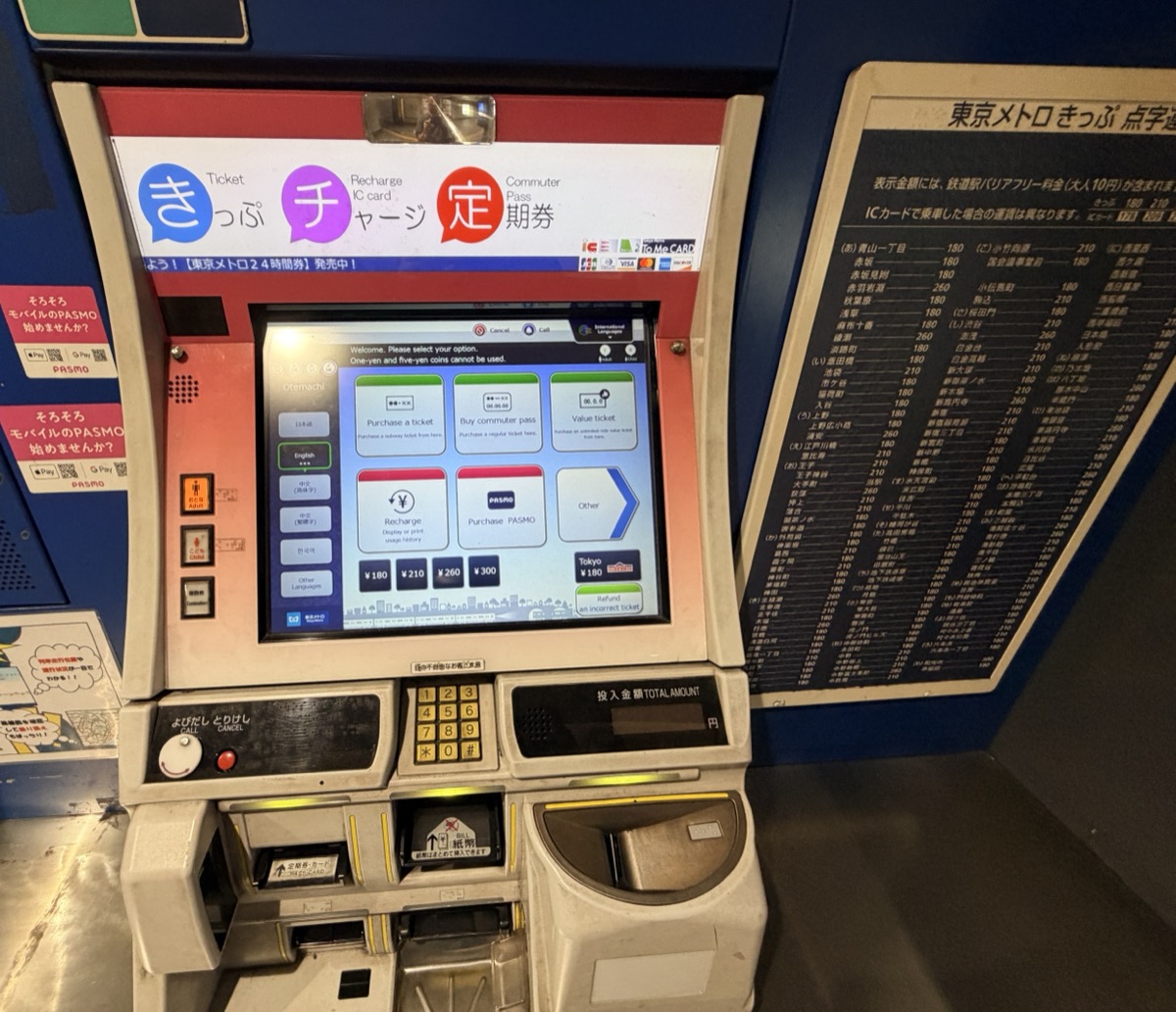
When the gate rejects your tap, do not queue behind yourself trying it again. Staff at the manned window will wave you through and point you at a paper ticket machine. English mode is a top-level button on those machines — not buried behind two menus. Buy a paper ticket to your destination, drop it into the paper slot on the gate, and walk. This is a sixty-second problem, not a stranded-at-the-airport problem.
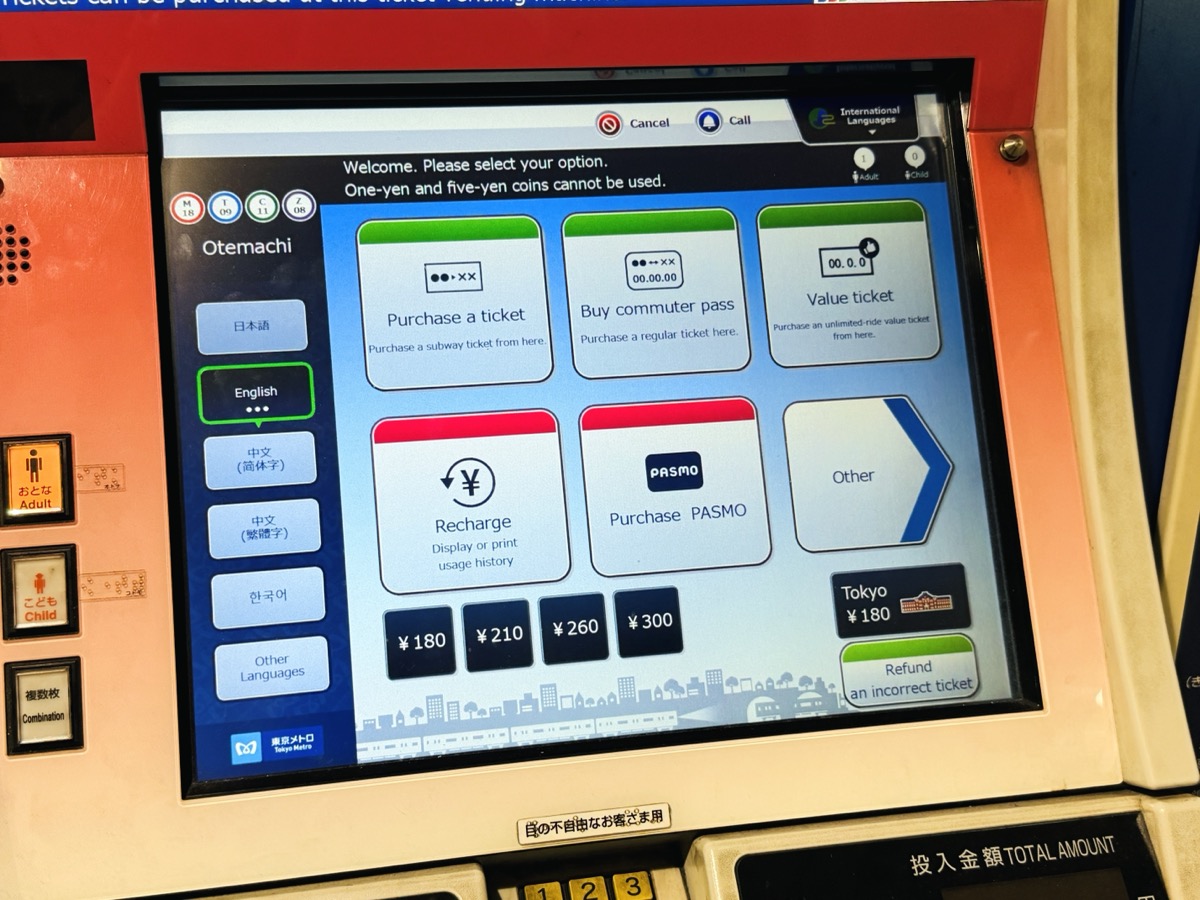
One thing worth knowing before you tap: there is no refund path at the station for a wrong or failed tap. Any dispute is handled through your card issuer, not the station office. If you accidentally ride past your stop, you cannot fare-adjust the tap at the exit machine either. The “Refund an incorrect ticket” button on the ticket machine is for paper tickets only, not for tap transactions.
Two more places the tap simply stops. You cannot start a journey at Nakano — tap is not available for boarding there, and if you tap in elsewhere and get off at Nakano you finish at the manned window. And if you stay on a through train past the edge of the scheme — onto JR East, the Saitama Rapid Railway or the Toyo Rapid Railway — the tap is voided from the station you started at. You then pay twice at a window: once for the stretch beyond the boundary, once for the stretch inside it, after walking back to a station in the covered area to clear the open entry record.
Both of those settlements have to be paid in cash. The system that let you arrive without buying an IC card will, in that one scenario, hand you back the exact problem you avoided. Keep a few thousand yen on you.
When you still need Suica
JR East is not in the scheme, and its trains run through the same station complexes you will use every day. The Yamanote loop, the Chūō and Sōbu lines, the Narita Express — all need Suica or a paper ticket. This is not an inference from a missing name on a list: Tokyo Metro’s own guidance says outright that you cannot ride from a Tokyo Metro line onto a JR East line on a tap, and that the transfer-only gates at Nishi-nippori, Ichigaya and Nishi-funabashi will not do it either. JR East is reported to be going a different route — gateless Suica around 2028. Until that lands, there is no tap-to-ride at a JR East gate, even if the gate is thirty metres from a Tokyo Metro gate that will read your Visa.
Buses are not in either. The scheme is a rail scheme — several of the eleven run bus networks too, and none of those buses are included. City buses, community buses, and the airport limousines all take Suica; none of them take tap.
Shops, konbini, vending machines, and coin lockers are patchy for foreign cards but universal for IC. Anywhere the Suica logo appears will accept a Suica; anywhere else, you need cash. That is a separate problem, covered elsewhere on this site.
If you need a Suica, the unregistered cards came back on 1 March 2025 after the chip-shortage suspension — registered ones had returned the autumn before — and the airport queues are shorter than the guides written in 2024 will tell you. There is also a tourist version, Tourist PASMO: valid for 28 days from purchase, no deposit and no refund, sold at Haneda and Narita by two railway companies each. JR East’s Welcome Suica is the equivalent on its side. Either works everywhere a standard Suica does.
The short answer
Tap for the metros. IC for everything else. The eleven-operator scheme covers Tokyo Metro, Toei, and nine private railways — rails only, not JR East, not buses, not shops. The tap fare is one to two yen dearer per ride than a Suica tap, which matters to almost no one — unless you are travelling with children, who are charged the adult fare on a tap and should stay on IC. Tap in and tap out with the same device or card — never mix an Apple Watch with a physical Visa. And do not let a Tokyo rush-hour ticket gate be the first contactless tap your card has ever made in Japan. Set up a Welcome Suica or Tourist PASMO at the airport if you need a fallback for buses and shops anyway.